Panic Attack Therapy in Whitley Bay and Online | CBT | James Blacklock
Panic attacks
Your heart races out of nowhere, and you're convinced something is badly wrong.

What is panic disorder?
A panic attack is a sudden rush of intense fear, with strong physical sensations like a racing heart, breathlessness or dizziness. They can feel terrifying, and many people end up in A&E the first time, convinced it's a heart attack.
Panic disorder is when panic attacks keep coming, often out of the blue, and you start living in fear of the next one. Some people begin avoiding places where escape or help might be difficult. That's sometimes called agoraphobia.
What you might notice
Sound familiar?
A racing or pounding heart, chest tightness or breathlessness
A sudden fear that you're dying, losing control or going mad
Constantly checking your body for signs of another attack
Avoiding supermarkets, public transport, driving or exercise
Feeling dizzy, faint, shaky or unreal
Always sitting near the exit, carrying water, or never going out alone
What keeps it going
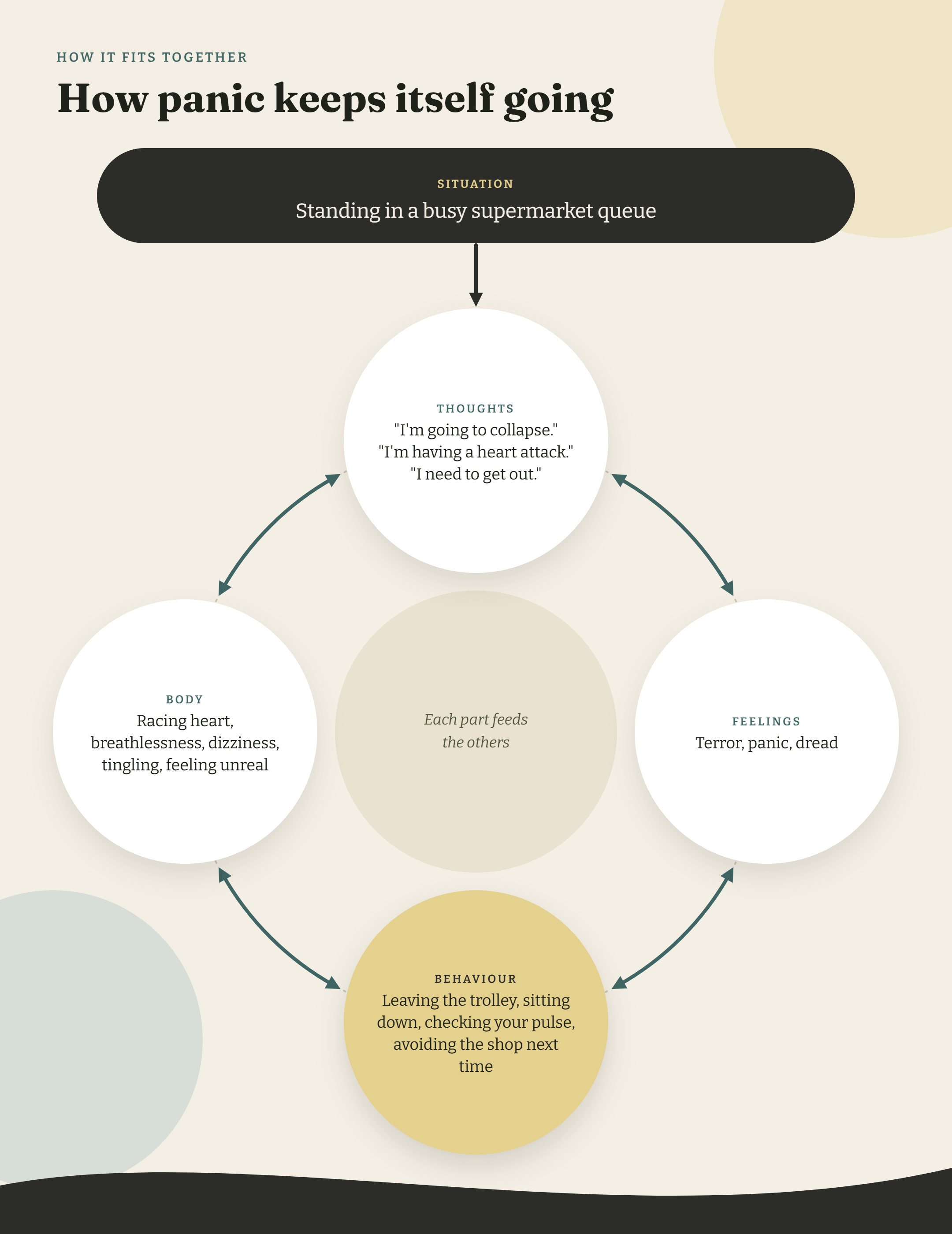
Panic starts with normal body sensations, the kind everyone gets, which are then misread as a sign of danger. A skipped heartbeat becomes "I'm having a heart attack." Feeling light-headed becomes "I'm going to faint."
That fear releases adrenaline, which makes the sensations stronger, which makes the fear stronger. It's a vicious circle that can peak within minutes. Then, sitting down, leaving or holding onto something seems to stop the disaster, so you never discover it wasn't going to happen.

How therapy helps
NICE recommends CBT for panic disorder. I use the cognitive model of panic developed by Professor David Clark, which has strong research support.
Together we'll make sense of your panic cycle, then test out the frightening predictions in a safe, planned way. That often includes bringing on the sensations on purpose, so you can see for yourself that they're uncomfortable but not dangerous. As the fear of the sensations fades, the panic attacks usually do too.
What working with me looks like
Treatment for panic is often fairly brief, commonly around 7 to 14 hours in total, depending on how much avoidance has built up. Sessions can be in person in Whitley Bay or online.
Questions people often ask
What if there really is something wrong with my heart?
If you haven't already, see your GP to rule out physical causes. Once that's done, we can work on the fear that keeps the panic going.
Should I just try to breathe through it?
Breathing techniques can help in the moment, but on their own they can become another safety behaviour. CBT tackles the fear underneath, so the attacks lose their power.
Can panic disorder really go away?
Yes. Panic responds very well to CBT, and many people become panic-free.